





















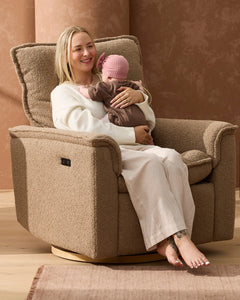
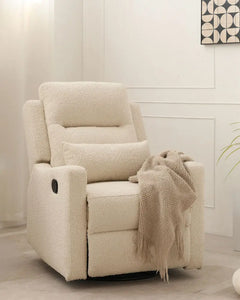


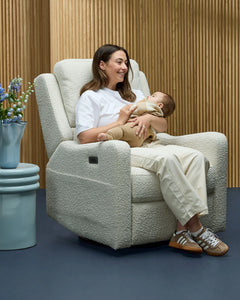
A nursing chair is a chair designed for feeding and settling your baby, with armrests at feeding height, a supportive backrest and usually a gliding or rocking motion. The right one depends on how you feed, the space you have, your recovery after birth and whether you want manual or electric recline. This guide walks you through what to check, with real specs from the chairs in our range.
The Short Version
- Choose the motion: glider (smooth back-and-forth on a fixed base), recliner (feet up) or rocking chair (curved runners). Many chairs combine glide, swivel and recline.
- Choose manual or electric: manual needs no power point; electric reclines at the push of a button and suits recovery after a caesarean.
- Check the fit: armrest height, seat depth, backrest height and weight capacity.
- Measure your space: electric recliners can be more than 1.5 metres deep when fully reclined.
Do You Really Need a Nursing Chair?
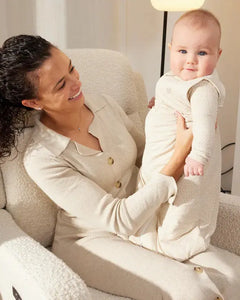
You don't have to have one, but most parents find it makes feeding easier on the body. In the newborn months you may feed 8–12 times a day, often at night. A chair with armrests at the right height and good back support can ease neck, shoulder and lower-back strain, and the gentle motion can help settle your baby. Many nursing chairs also move to the lounge room once the feeding years are over.
Glider, Recliner or Rocking Chair?
Glider chairs move smoothly back and forth on a fixed base, and most also swivel. The motion is quiet and even, which many parents find soothing during night feeds.
Glider recliners add a footrest and backrest that recline so you can put your feet up. Most of the chairs in our range are glider recliners, such as the iL Tutto Chelsea, Cocoon Plush and Babyrest Celeste.
Rocking chairs rock on curved runners. They're usually lighter and slimmer than recliners but don't recline. The Quax Rocking Nursing Chair weighs 13kg, compared with 40–55kg for most electric recliners.
Manual or Electric Recline?
A manual recliner uses a lever or spring-loaded mechanism and doesn't need a power point, so it can go anywhere in the room. An electric recliner moves at the push of a button, so you can recline and sit up without using your core. Many parents find this helpful after a caesarean. Most electric models also have USB charging.
- Manual glider recliners in our range: iL Tutto Chelsea, iL Tutto Quinn, Cocoon Rio and Cocoon Plush.
- Electric recliners in our range: iL Tutto Frankie, iL Tutto Henry Plus, Babyrest Celeste, Babyrest Harlow and Ubabub Arc.
Browse all electric nursing chairs or manual nursing chairs.
Features That Matter for Breastfeeding
- Armrest height: armrests should support your elbows while you hold your baby at the breast or bottle. A nursing pillow can make up the difference.
- Seat depth and height: you should be able to sit back fully with your feet flat on the floor. The Cocoon Plush, for example, has a 53cm seat depth and a 49cm seat height.
- Back and neck support: taller parents may prefer a high backrest. The Babyrest Harlow has separate lumbar and head support. The iL Tutto Henry Plus has an adjustable air lumbar cushion.
- Swivel range: swivel lets you turn to the cot or change table without standing up. The range varies by model: 360° on the iL Tutto Chelsea and Cocoon Plush, 315° on the Babyrest Harlow, 270° on the Ubabub Arc, 240° on the Babyrest Celeste and 180° on the iL Tutto Henry Plus.
- Weight capacity: check the listing. The Babyrest Celeste, Babyrest Harlow and Quax Rocking Nursing Chair are rated to 150kg, and the iL Tutto Chelsea and Ubabub Arc to 130kg.
- Extras: USB-A and USB-C charging keeps your phone or monitor topped up. The iL Tutto Henry Plus adds back massage with 3 settings and seat heat.
How Much Space Does a Nursing Chair Need?
Rocking chairs are the most compact, recliners need room in front and behind, and electric recliners need a power point within reach.
- Quax Nordic Rocking Chair: 82cm L x 74cm W x 86cm H
- iL Tutto Quinn (manual recliner): 100cm H x 76cm W x 80cm D upright
- Babyrest Harlow (electric): 88cm deep upright, 153cm fully reclined
- Babyrest Celeste (electric): 95cm deep upright, 164cm fully reclined, with a 3.4m power lead
Measure the spot you have in mind, including the space a recliner needs behind the backrest, and check the dimensions in each listing.
Quick Comparison
- iL Tutto Chelsea | Manual glider recliner | 360° swivel | Spring-loaded recline, high backrest, 130kg capacity
- Cocoon Plush | Manual glider recliner | 360° swivel | Full recline, high backrest, hand-upholstered fabric
- iL Tutto Frankie | Electric glider recliner | 180° swivel each side | Push-button recline, USB-A and USB-C, wooden base
- iL Tutto Henry Plus | Electric glider recliner | 180° swivel | Back massage, seat heat, air lumbar support, extended footrest
- Babyrest Celeste | Electric glider recliner | 240° swivel | One-action recline, 125° recline, 3.4m lead, 150kg capacity
- Babyrest Harlow | Electric glider recliner | 315° swivel | Separate powered recline, lumbar and head support, 150kg capacity
- Ubabub Arc | Electric glider recliner | 270° swivel | Controls hidden in the armrest, GREENGUARD Gold certified, 130kg capacity
- Quax Rocking Nursing Chair | Rocking chair | No swivel | Solid birch runners with felt underside, washable fabric, 150kg capacity
Using Your Nursing Chair Safely
- Don't fall asleep holding your baby in a nursing chair, recliner, sofa or armchair. It's a recognised sleep risk. If you feel drowsy during a feed, place your baby on their back in their own cot or bassinet.
- Keep little hands clear of the recline mechanism, footrest and rocking runners, and don't let children play on the chair.
- Keep power leads tidy and out of children's reach on electric models.
- Check fittings and tighten any screws or bolts that loosen over time.
Frequently Asked Questions
Is a nursing chair worth it?
For most parents, yes. You'll spend many hours feeding and settling in the first year, and a chair with the right arm height, back support and motion makes those hours more comfortable. Many nursing chairs also suit the living room later.
Is a rocking chair good for nursing?
Yes. A rocking chair gives a natural rhythm that many babies find soothing, and it's usually lighter and more compact than a recliner. It won't let you put your feet up, so some parents add an ottoman. The Nuage Interiors Cloud Rocker comes with one.
What's the difference between a glider and a rocking chair?
A glider moves smoothly back and forth on a fixed base and often swivels and reclines. A rocking chair rocks on curved runners and is usually simpler and lighter. Choose the motion you find most comfortable.
Should I get a manual or electric nursing chair?
Choose manual if you want a chair that can go anywhere without a power point. Choose electric if you want to recline and sit up without using your core, which many parents find helpful after a caesarean.
What should I look for in a nursing chair?
Check the armrest height, seat depth, back and neck support, swivel range, weight capacity and the space the chair needs when reclined. Then choose the motion (glide, recline or rock) and the fabric that suit your nursery.
Can I use a nursing chair after the baby years?
Yes. Many nursing chairs are designed to move into the lounge room or bedroom later. Timber bases and textured fabrics such as bouclé and corduroy help them fit in, and Nuage Interiors rockers can swap their rocking blades for fixed legs.
Ready to compare? Browse our full range of nursing chairs, including iL Tutto nursing chairs, electric recliners and manual glider recliners.